
Help! My Boyfriend Is Emotionally Unavailable. Could Culture Be Part of the Reason?

You’ve probably found yourself rehearsing the words in your head: “I love you, and I know you love me, but for some reason I still feel alone…” And you already know his response — the pause, the shrug, the quiet “I don’t know…” It’s not mean or dismissive, it’s just… unavailable.
It’s confusing because you know he’s a good partner. He’s loyal, responsible, caring, and works hard for the people he loves. And yet, when it comes to emotional presence, he can’t quite show up in the way you need. Sometimes the most painful kind of loneliness isn’t from being alone. Rather, it’s feeling disconnected from someone you love.
In cross-cultural and collectivist relationships, this is surprisingly common. You can see his love in actions, but the emotional intimacy you crave feels out of reach. We often call this an emotionally unavailable partner, but that label alone, misses the deeper layers of: gender socialization, cultural norms around expressing emotions, attachment patterns, and the ways emotional safety gets prioritized over vulnerability. This isn’t about blaming him or his culture. It’s about understanding the complex mix of upbringing, culture, and emotional capacity. And it deserves a conversation that honours both the context that shaped him and, the emotional connection you are allowed to need.
In this post, we’ll explore what emotional unavailability really looks like, how culture shapes it, and most importantly, what you can do when you love someone who struggles to meet you emotionally.
What Emotional Unavailability Actually Means & Why Men Tend to Struggle with it?
Emotional unavailability isn’t about a lack of love. It’s about a partner who struggles to show up emotionally — who finds it hard to share feelings, be vulnerable, or connect on a deeper level. You might notice distance, withdrawal, or a kind of quiet detachment, even when it’s clear they care in other ways.
A lot of this starts in childhood. In many collectivist cultures, boys are often taught that showing sadness, fear, or uncertainty is a weakness. Over time, they learn to contain emotions rather than share them. This becomes a survival tactic carried into adulthood, showing up as shutting down, avoiding tough conversations, or keeping walls up.
It’s rarely about wanting to hurt anyone — it’s simply what was learned early on: that feelings are dangerous, private, or inconvenient. Many of these patterns tie into an avoidant attachment — when children grow up feeling like it isn’t safe to express themselves, they learn to rely on themselves, hold their guard up and retreat whenever emotions feel too intense.
Signs that your Partner is Emotionally Unavailable

Sometimes the signs of emotional unavailability aren’t obvious at first, but over time, certain patterns start to feel familiar:
Difficulty expressing emotions – You ask how his day was, and all you get are short surface level answers.
Avoiding vulnerability – He keeps stress, fear, or sadness to himself, even when it would make sense to share.
Withdrawing during conflict – Arguments end with him going silent, leaving the room, or scrolling on his phone instead of engaging.
Struggling with empathy or attunement – When you open-up about a tough day, he jumps to solutions or logic instead of acknowledging how you feel.
Default response is “I don’t know” – Ask about his feelings and you often get a shrug or a blank “I don’t know.”
Avoids deep conversations – Talks stay surface level. The deeper stuff? Totally off-limits
Labels emotions as “dramatic” – When you bring up your feelings, he might roll his eyes, joke, or say you’re overreacting
Even with loyalty, love, and reliability in other areas, these behaviours can leave you feeling disconnected and lonely. Recognizing these patterns helps you understand what’s really happening and what you need (or what is lacking) to feel seen and emotionally supported.
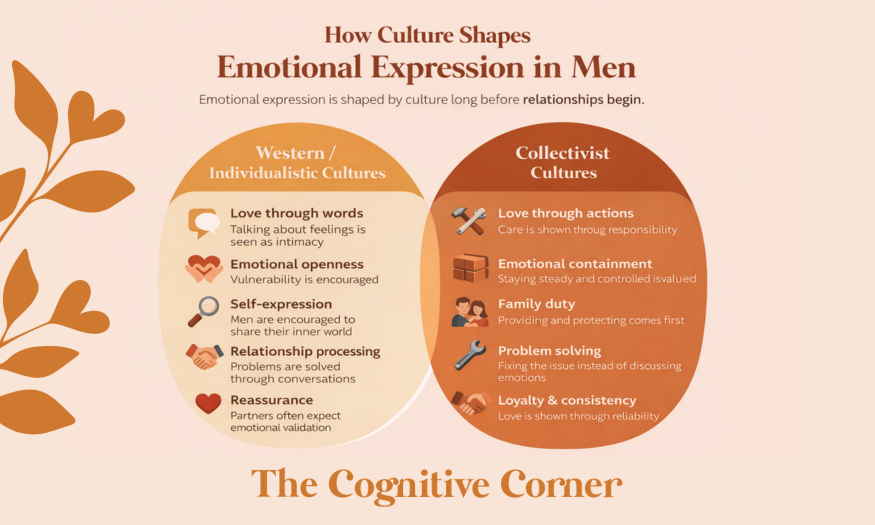
How Culture Shapes Emotional Expression in Men?
Emotional expression doesn’t exist in a vacuum — it’s shaped by culture, long before we ever enter a relationship
In Western, individualistic cultures, love is often measured by emotional openness. We’re taught that intimacy looks like talking about your feelings, being vulnerable, offering reassurance, saying “this is what’s happening inside me.” Words matter. Emotional transparency matters.
But inmany collectivist cultures, love isn’t centred around emotional language. It’s centred around responsibility. Love can look like:
Working hard to provide
Staying loyal and consistent
Showing up in practical, dependable ways
Prioritizing family stability
Fixing problems instead of talking about them
From a young age, many men are taught that being “strong” means staying steady, private, and in control. Emotions aren’t denied — they’re contained. Not because they don’t feel deeply, but because expressing those feelings was never modeled as safe, useful, or necessary.
Low Emotional Awareness vs Cultural Expression — What’s the Difference?
This is where things get nuanced — because on the surface, these dynamics can look very similar. A partner who struggles emotionally, and a partner shaped by cultural norms around emotional privacy, may behave in ways that feel equally distant.
A partner with low emotional awareness often lacks both the skill and the willingness to engage emotionally. Conversations about feelings may quickly shut down or turn defensive. It might sound like:
“I just don’t think about that stuff”
“I can’t do anything right”
“Okay… but what do you want me to do about it?”
“Can you just let it go?”
“It’s not that serious”
In these moments, the issue isn't just discomfort with emotions or valued privacy — it’s a lack of engagement with them.
A partner shaped by collectivist cultural norms, however, may experience emotions — but the language to express them isn’t always there. It might sound more like:
“I don’t really know how to explain it”
“You know I love you. I wouldn’t be doing all of this if I didn’t”
“I need some time to think. I don’t want to say the wrong thing”
“Help me understand”
“I don’t want to upset you”
The key difference is that the emotional capacity may still be there — your partner just hasn’t learned how to put those feelings into words or express them safely.
So, the real question becomes: is your partner struggling but trying to meet you halfway? Or is he refusing to grow, dismissing your needs, and using culture as a shield?
When It’s Not Just Culture?

Understanding cultural context can help explain how someone learned to relate to emotions — but it doesn’t mean you have to tolerate emotional harm.
There’s a difference between a partner who feels unsure how to show up emotionally and one who has no interest in trying.
Some red flags to pay attention to:
Invalidating your feelings – “you’re too sensitive”
Shutting down vulnerability – “I’m tired of talking about feelings”
Gaslighting – “That never happened”
Refusing growth – “This is just who I am”
When these patterns are consistent, the issue is no longer about cultural difference — I’ts about emotional disconnection and neglect.
There’s a big difference between someone saying, “im not used to this, but I want to understand,” and someone saying, “This is the way I am — deal with it.” One is stretching, the other is shutting the door.
Wanting closeness, vulnerability, and emotional safety isn’t dramatic — it’s human. You’re allowed to respect cultural differences and still want emotional intimacy. Those things can absolutely co-exist.
But you should never be made to feel like your needs are excessive simply because someone else hasn’t learned how to meet them.
What You Can Do if your Partner is Emotionally Unavailable?
If you’re in a cross-cultural relationship and feeling emotionally alone, the goal isn’t to force your partner to become someone they’re not, it’s to build a bridge between two emotional worlds.
Shift from accusation to curiosity
Instead of, “You never open up to me,” try asking, “How were emotions handled in your family?”
Curiosity lowers defensiveness, inviting understanding instead of shame. Especially for men who were taught to suppress their feelings.
Model emotional language
For many people, especially those with avoidant attachment, emotional vocabulary is a skill you learn over time. Try naming your experience in simple, grounded ways:
“It helps me feel close to you when we share our feelings”
You’re not demanding, you’re demonstrating.
Set clear boundaries around your needs
Cultural understanding doesn’t mean self-abandonment, you can still honour his background by saying, “This is important for me to feel secure and close to you”
Your needs don’t disappear simply because your relationship is cross-cultural.
Learn the difference between capacity and unwillingness
Ask yourself:
Is he trying, even if it’s awkward?
Is there small movement over time?
Is there care behind his discomfort?
Growth can be slow can clumsy at first. But if there is no effort or accountability, that’s not culture, that’s emotional unavailability.
Consider Relationship Therapy or Couple’s therapy ideally
Sometimes meaningful change needs support. At The Cognitive Corner, our therapists understand cross-cultural relationships, avoidant attachment, and emotionally distant dynamics.
Mina, Kaitlyn, and Gabriella, support clients across Alberta, Ontario, British Columbia, Manitoba, Saskatchewan, Newfoundland & Labrador, and the Northwest Territories. Using approaches like The Gottman Method, Emotion-Focused Therapy, culturally responsive therapy, and attachment-based work, they help partners translate emotional needs across different cultural backgrounds and relational languages.
In couples therapy, the goal isn’t about blaming or pathologizing either partner. It’s about honouring cultural values, building emotional awareness and safety, and creating new patterns of connection. If this feels aligned, you’re welcome to book a complementary 15-minute consultation with one of our therapists. You deserve a love that’s not only shown through responsibility but also felt through connection.
TL;DR
Emotional unavailability isn’t always a lack of love. Often, it’s a learned pattern — shaped by childhood and, in many collectivist cultures, by norms that value emotional privacy, strength, and responsibility over verbal vulnerability. Love may be shown through provision and loyalty rather than emotional language.
It becomes a problem when there’s no effort to understand your feelings, no emotional safety, and no willingness to grow.
If you feel consistently lonely or dismissed, that matters. Awareness is the first step. From there, change can happen through honest conversations, boundaries, and sometimes culturally responsive couples therapy.
References:
https://love-diversity.org/non-expressive-love-in-traditional-cultures/
https://www.healthline.com/health/emotionally-unavailable