
Internal Family Systems Therapy Explained: Understanding Your Inner Parts

Have you ever felt like there are multiple versions of you living inside your mind — each one wanting something different, especially when it comes to healing? Almost like there’s a whole little world inside, kind of like the Disney movie Inside Out, where different emotions or voices take turns at the front. One part of you might feel ready to move forward, while another feel scared, stuck, or just not ready to let go.
You might notice it in the small, everyday moments. A part of you wants to send the message, and another immediately says, don’t, it’s not safe. A part of you wants to rest, while another pushes you to keep going. You might feel confident one minute, and then suddenly unsure of yourself the next. It can feel confusing, even frustrating — like you’re contradicting yourself or just can’t “make up your mind.” But this isn’t you being inconsistent. It’s the different parts of you, each with their own thoughts, emotions, and experiences, all trying to do their job. And when it comes to healing, that push and pull can feel even stronger. There’s a version of you that wants to grow, and at the same time, another part is trying to protect you by holding back, staying quiet, or avoiding what feels like too much.
This is exactly whatInternal Family systems (IFS) therapy is built on. The idea that every part of you has a role, and that healing begins not by pushing those parts away, but by learning to understand them with curiosity and compassion.
By the end of this reading, you’ll have a better understanding of what IFS therapy is, how it works, who it can support, and what it might feel like to experience it in therapy.
What Is Internal Family Systems Therapy? And What “Family” Are We Talking About?
Internal Family Systems therapy(IFS) is based on a simple but powerful idea: we all have different “parts” within us, and each one serves a purpose. Even the parts that feel frustrating, confusing, or overwhelming are usually trying to protect you in some way. Instead of seeing them as something to fix or get rid of, IFS helps you understand where they came from, what they’re trying to do, and what they might need.
Now, what does this have to do with our families? Well, it’s not so much about your external family, but rather you internal one.
Just like how each member of your family has a role, your inner world is made up of different roles, each with their own perspective, emotions and ways of responding. Together, they form an inner system. So, when it feels like one part of you wants one thing, and another wants something completely different, that’s your internal “family” at work.
IFS therapy helps you get to know these parts, understand their roles, and create more balance within yourself.
Speaking of Disney movies, one of the most accurate portrayals of Internal Family Systems (IFS) is “Encanto”. The film beautifully acts as a metaphor for how different “parts” of us show up, interact, and how healing may look like.
Understanding the “Parts” in IFS
To understand how IFS therapy works, it helps to get familiar with the different “characters” in your inner world. These parts ted to fall into a few key roles.
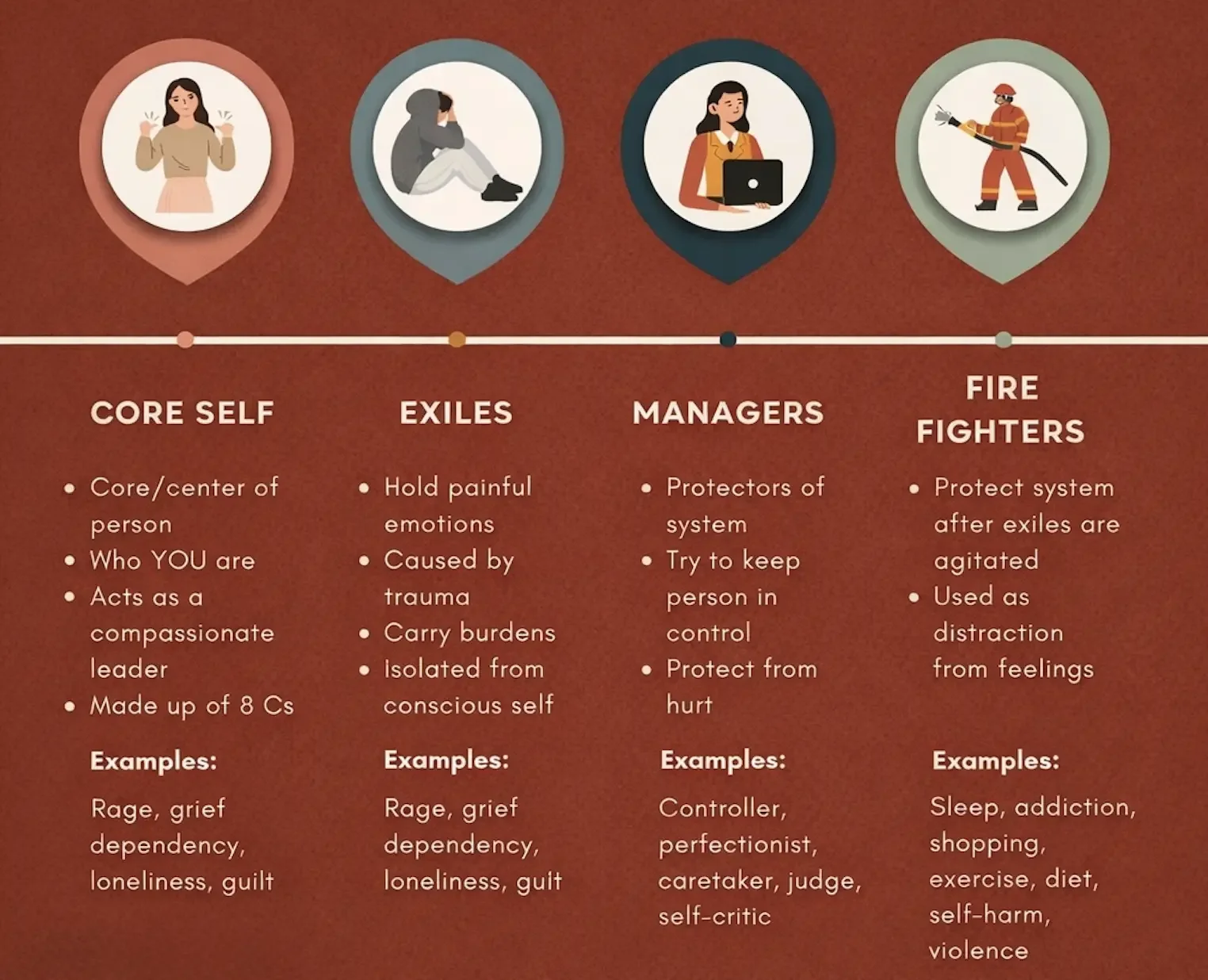
Managers
Mangers are the parts of you that try and keep everything under control. They plan, overthink, people-please, and try to prevent anything from going wrong.
You might notice this when you:
replay conversations in your head
hold yourself to high standards
try to say or do the “right thing” to avoid conflict
stay busy so you don’t have to slow down
These can feel exhausting at times, but they’re trying to keep you safe by staying one step ahead.
Firefighters
Firefighter step in when emotions feel overwhelming. If managers try to prevent pain, firefighters step in when the pain is already there and try to shut it down quickly.
You might notice this when you:
doom scroll, binge-eat, or turn to sex, drugs, and/or alcohol for distractions
shut down emotionally or go numb
Act impulsively or say something you didn’t fully mean
Try to escape what you’re feeling
Their goal is relief in the moment, even if it doesn’t help long-term
Exiles
Exiles are the parts that carry deeper emotional pain often from earlier childhood experiences.
They can hold feelings like:
Shame
Fear
Loneliness
Childhood Pain
Because these feelings can be intense, other parts work hard to keep them buried. These parts aren’t trying to cause pain — they’re holding pain that hasn’t had the chance to be fully seen or processed yet.
The Self
At the heart of this system is what IFS calls the Self.
The Self isn’t another “part” — it’s the core of who you are. It’s the version of you that feels calm, grounded, and clear. The one that can pause, reflect, and respond instead of react.
You might notice the self in moments when you:
feel present and not overwhelmed
respond with curiosity instead of judgement
feel compassion for yourself and others
have a sense of clarity or inner calm
In IFS, the goal isn’t to get rid of your parts, it’s to help the Self lead.
When that happens, your parts don’t have to work so hard. The overthinking part can relax. The part that shuts down can feel safer. Even the parts holding deeper pain can begin to open up.
And from that place, real healing can happen more naturally.
What Happens in an IFS Therapy Session, How Does IFS Therapy Work? And, How is it Different from Talk-Therapy?
So what does IFS therapy actually look like in a session? To help bring this to life, we asked one of our therapists at TCC, Mina, how she works with this approach.

Mina, therapist at TCC trained in Internal Family Systems, explains IFS in a way that feels accessible, non-pathologizing, and deeply human. Instead of focusing on what’s “wrong,” she helps clients understand their parts — like the part that strives, avoids, tries to stay in control — framing them as protective adaptations that developed for a reason.
In session, this looks a bit different from traditional talk therapy. Instead of only talking through your experiences, you’re guided to slow down and notice what’s happening inside of you in real time.
A session might start with a feeling, thought, or body sensation. From there, you gently get curious about the part connected to it:
What part of me is showing up right now?
What is it trying to do for me?
What might it be protecting me from?
Rather than trying to fix or push it away, you begin to build a relationship with it.
Mina also integrates somatic work, helping clients notice how these parts connect to the nervous system (like fight, flight, or freeze). Each part has its own way of protecting you. One of the most powerful shifts she sees is when a client moves from, “What’s wrong with me?” to “What happened to me, and how did my system adapt?”
This alone can reduce shame and open the door to self-compassion. From there, parts begin to soften. Clients often feel less reactive, more regulated, and more connected to themselves. As this work deepens, many people begin to access their Self.
What Internal Family Systems (IFS) Can Help with and Who It’s For
As you begin to understand your internal system, patterns that once felt confusing often start to make more sense.
IFS therapy can support a wide range of emotional experiences especially the ones that feel layered, overwhelming, or hard to untangle. It’s often helpful when you feel stuck in patterns you can’t quite explain — like wanting to move forward while another part holds you back.
IFS is commonly used to support:
trauma and PTSD
anxiety and overthinking
depression or feeling stuck
attachment wounds and relationships challenges
people-pleasing or perfectionism
emotional regulation and overwhelm
childhood trauma and unresolved experiences
You don’t need a diagnosis for this work to be meaningful.
Many people are drawn to IFS therapy simply because they want to understand themselves more deeply.
It can be especially supportive if you:
feel like different “parts” of you are in conflict
notice patterns you can’t seem to shift on your own
are tired of being hard on yourself and want a more compassionate approach
want to understand your emotions rather than push them away
feel curious about your inner world and how your experiences have shaped you
This work meets you wherever you are; whether you’re navigating something heavy, or simply wanting to feel more connected to yourself.
How IFS therapy Helps You Strengthen Your Sense of Self

Over time, this work helps you build a stronger relationship with your Self — the part of you that feels steady, clear, and grounded. Instead of feeling pulled in different directions, you begin to feel more connected, more regulated, and more like yourself.
At The Cognitive Corner (TCC), several of our therapists — Ash, Mina,Kaitlyn, and Brynlyn — are trained in Internal Family Systems (IFS) therapy who can support you through this process in a way that feels safe, collaborative, and tailored to you.
If you’re curious about IFS or wondering if it might be a good fit, you’re welcome to book a free 15-minute consultation with a therapist in Canada. It’s a chance to ask questions, explore options, and see what feels right for you
You don’t have to figure it out on your own. The parts of you that feel confused, stuck, or overwhelmed make sense — and with the right support, we hope to make you and all your different parts, feel more understood.
TL;DR
Internal Family Systems (IFS) therapy is based on the idea that we all have different “parts” within us — the Manager, the Firefighter, and the Exile. IFS therapy emphasizes that these parts aren’t problems; they’re protective responses shaped by your experiences.
Instead of trying to fix or get rid of these parts, IFS helps you understand them with curiosity and compassion. In therapy, you learn how to connect with these parts, understand what they’re trying to protect you from, and build a different relationship with them.
Over time, this creates space for your core Self — the part of you that feels calm, grounded, and clear — to lead.
IFS can support things like trauma, anxiety, and relationship patterns, but it’s also for anyone wanting to understand themselves more deeply and feel more connected, regulated, and at ease within their own mind.
References:
https://ifs-institute.com/
https://www.goodwomantherapy.com/blog/who-is-ifs-therapy-best-for
https://www.goodwomantherapy.com/blog/an-ifs-therapist-reacts-inside-out-2
https://psyche.co/guides/how-to-get-to-know-and-love-all-the-parts-of-your-self
https://www.youtube.com/watch?v=fzevlBt5HUAhttps://orchardvalleycounselling.ca/methods/finding-inner-harmony-a-deep-dive-into-internal-family-systems-ifs-theory-and-its-role-in-modern-counselling/
https://www.therapyinbarcelona.com/ifs-therapy-explained-a-guide-to-internal-family-systems/