
“I Can’t Feel It in My Body” — Why Emotional Disconnect Happens & How to Reconnect With your Body?

Most of us have been there. You’re sitting in therapy, the conversation is getting deeper, you’re talking about something that actually matters — and then your therapist asks:
“Where do you feel that in your body?”
And your mind goes completely blank. You pause. Maybe you laugh a little, maybe you feel a bit awkward, and you say, “I don’t know.” But internally, there’s more going on. You might notice that you can think about what you’re feeling; You can explain it, analyze it, even make sense of it logically. But actually feeling it in your body? That feels out of reach — almost like there’s a disconnect between your mind and everything else.
If this sounds familiar, you’re not alone. Many people move through the world feeling “in their head,” disconnected from their body, or unsure of what they’re feeling on a deeper level. You might feel numb, flat, or just not fully present. And while it can feel frustrating — or even a bit scary — it’s not a sign that something is wrong with you. More often than not, this kind of mind-body disconnection is actually a protective response.
When emotions feel overwhelming, unsafe, or too much to process, the body has a way of adapting. Sometimes that means turning the volume down on sensations, or shifting you into thinking mode as a way to cope.
In this post, we’ll explore what it really means to feel disconnected from your body, why it happens, and how approaches like somatic therapy can help you gently reconnect — at your own pace, in a way that feels safe.
What Does It Mean to Feel Emotionally Disconnected from Your Body?
Feeling disconnected from your body can be hard to put into words — because if you can’t quite feel what’s happening, how do you even begin to describe it? You might be able to think clearly, analyze a situation, and even name your emotions. But actually experiencing them in your body feels distant or unclear.
Mind–body disconnection can sometimes look like:
difficulty noticing physical sensations (like tension, tightness, emptiness, or fatigue)
feeling numb, flat, or emotionally muted
spending most of your time in your thoughts rather than your body
struggling to identify what you are feeling
finding it hard to stay present in the moment
It can also show up in small everyday ways, especially when it comes to your body’s basic signals:
drinking water only when you only feel dehydrated (dry mouth, headache)
needing to use the bathroom but continuing to delay it until the last moment

pushing through hunger because you’re “too busy” and then feeling irritable or shaky later
realizing your exhausted only when you can't keep your eyes open any longer
staying in the same position for long periods of time without adjusting even when it’s uncomfortable
holding your breath or breathing shallowly without noticing
pushing through hunger because you’re “too busy” and then feeling irritable or shaky later
These moments can be easy to overlook, but they can also feel confusing — especially if you remember being more connected in the past, or if you’ve never really known what that connection feels like. Even if it doesn’t make sense right now, there’s usually a reason your system learned to respond this way.
Why Does Disconnection Happen?
At some point, fully feeling your emotions may have felt like too much, or simply wasn’t possible. So, your body adjusted. Instead of taking everything in at full intensity, it learned how to dial things down, tune things out, or create a bit of space. Not in a dramatic way, but in small, quiet ways that helped you keep going.
This isn’t something you chose on purpose. It’s something that developed over time, often without you even realizing it was happening. And while it might not feel helpful now, these patterns often started as a way to get you through something difficult.
Here are some of the ways this can take shape:
Trauma
When something feels too overwhelming, like experiencing trauma, the body may not fully process it in the moment. Instead, it creates distance so you can keep functioning. Later, this can show up as feeling disconnected — especially when something feels familiar to past experiences.
Chronic Stress & Burnout
When you’ve been running on empty for a long time, your body shifts into survival mode. The focus becomes getting through the day, meeting demands, and holding everything together. Over time, that constant pressure like chronic stress and burnout can make it harder to slow down or notice what’s happening internally.
Emotional Suppression
If emotions weren’t safe to express growing up, you may have learned to push them aside without thinking twice. Over time, emotional suppression can become a habit— where feelings are muted before you even register them.
Anxiety & Overthinking
When your mind is always “on,” it can pull your attention away from your body. You might find yourself stuck in loops of analyzing, planning, or trying to stay in control, fueled by anxiety. The more you rely on thinking to manage things, the easier it is to lose touch with what you’re actually feeling.
Dissociation
Dissociation can feel like a sense of distance from yourself or your surroundings. It might look like zoning out, feeling numb, or not fully being present. While it can feel unsettling, it often happens when your body is trying to reduce the impact of something that feels like too much to take in all at once.
What Is Somatic Therapy and How it can help with mind-body disconnection?
You may have heard the phrase “the body keeps the score.” While it comes from a well-known book by Bessel van der Kolk, it’s also a common way of describing something many people experience — that our bodies hold onto more than we realize. Even when something feels like it’s in the past, your body can still carry the imprint of it. This can show up as tension, numbness, restlessness, or a sense of disconnection that’s hard to explain.
Somatic therapy works with this mind–body connection. Instead of only talking through your experiences, it gently brings your attention to what’s happening physically — your breath, sensations, and how your body responds. The goal isn’t to feel everything all at once, but to slowly rebuild awareness in a way that feels manageable.
Over time, this can help you:
notice sensations more clearly
feel more present and grounded
process emotions through the body
regulate your nervous system
reduce numbness
reconnect with yourself
This is where somatic work becomes important; by supporting your body in processing what your mind already understands.
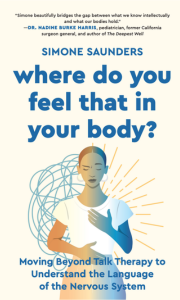
Simone Saunders, a somatic therapist in Canada, wrote a book “Where Do You Feel That in Your Body?” that digestibly explains how and why emotional and body disconnection happens, while offering practical, easy-to-follow tools and routines to help you reconnect with your body and build greater self-awareness, so you actually know where do you feel it in your body. Learn more about it via the button below:
What Reconnecting with Your Body Can Feel Like?
Reconnecting doesn’t usually happen all at once. It tends to show up in small subtle ways. It might start with noticing tension in your shoulders or becoming aware of your breath without trying to change it. For some, it feels like becoming more present. For others, it’s a sense of coming back to themselves after feeling distant for a long time.
You might notice:
sensations like warmth, tightness, or heaviness
emotions becoming clearer
less overthinking and over analyzing
a better sense of your needs and limits
It’s not always comfortable at first. If your body has been in a protective state for a long time, even small moments of awareness can feel unfamiliar. Over time, many people begin to feel more grounded, more aware, and more connected to themselves. And it doesn’t have to be perfect to be meaningful. Even small moments of noticing, feeling, or being present can be a sign that things are starting to shift.
Gentle Ways to Start Reconnecting with Your Body
The goal isn’t to force anything, it’s about starting small and letting your body set the pace. Here are a few gentle ways to begin:
Body Scanning
This is about checking in, not figuring anything out. Take a moment to pause and ask yourself: What’s here right now? You might notice tension, heaviness, or nothing at all — and that’s okay. The goal is simply to begin noticing.
Grounding Through your Senses
This helps you step out of your head and reconnect with what’s happening around you. Bring your attention to simple things in your environment — the feeling of your feet on the ground, the support of the chair beneath you, or the space around you. The goal isn’t to look inward, but to help you reconnect with where you are in this moment.
Gentle Movement
Sometimes it’s easier to connect through movement rather than stillness. Try stretching, walking, or even shaking out your arms. You’re not trying to do anything perfectly — just noticing your body as it moves.
Engage your Senses
This is about giving your system something to respond to. You might try running your hands under warm water, lighting a scented candle, listening to music, or tasting something strong like sour candy.
These small sensory moments can help “wake up” your awareness in a way that feels easy and low-pressure.
Breath Awareness
This is a quieter way of reconnecting.Instead of trying to control your breath, just notice it. Is it fast or slow? Shallow or deep? There’s no need to adjust it — simply observing can help you feel more connected over time.
The most important thing to remember is that this takes time.
If reconnecting feels difficult, that doesn’t mean you’re doing it wrong. It just means your body has learned to protect you in a certain way — and it may take some patience to build that connection again. While small steps on your own can make a difference, reconnecting with your body can feel a lot easier when you’re not doing it alone.
How Therapy Can Help You feel it in your body?
Working with a therapist gives you a space where you don’t have to figure it all out by yourself. Instead of guessing what you’re “supposed” to feel, you’re guided in a way that feels steady and manageable.
At The Cognitive Corner, therapists like Ash and Mina use mind–body approaches, including somatic therapy, to support this kind of work.
In session, this might look like:

gently noticing sensations without needing to explain them
learning how to regulate when things start to feel overwhelming
understanding how your body responds to stress or past experiences
building awareness in a way that feels supportive, not forced
Approaches like somatic, EMDR, and sensorimotor therapy are designed to help you reconnect at a pace that doesn’t feel overwhelming. Over time, many people begin to feel more grounded, more aware, and more connected to themselves. And just as importantly, there’s often a shift in how you see yourself — realizing your body was never working against you, but trying to support you in the best way it could.
Conclusion
Reconnecting with your body doesn’t happen overnight, and it doesn’t have to. Even small moments of awareness are a step in the right direction. If you’ve been feeling disconnected, it’s not a sign that something is wrong with you. It’s often a sign that your body has been trying to take care of you in the only way it knew how. With time, patience, and the right support, that connection can come back.
TL;DR
Feeling emotionally disconnected from your body is more common than you might think. It often develops as a protective response when something feels overwhelming, stressful, or unsafe.
This can show up as numbness, overthinking, or difficulty noticing physical sensations and emotions.
Somatic therapy helps reconnect the mind and body by gently bringing awareness back to physical sensations in a way that feels safe and manageable.
Reconnection doesn’t happen all at once — it often starts with small moments of awareness, like noticing your breath or tension in your body.
With time (and support), it’s possible to feel more present, more grounded, and more connected to yourself again.
References:
https://www.ncbi.nlm.nih.gov/books/NBK207191/
https://pmc.ncbi.nlm.nih.gov/articles/PMC9720153/
https://www.thebreatheffect.com/mind-body-connection-2/
The Body Keeps The Score: https://drive.google.com/file/d/1GGA6axs88gCT749IaD1z3Kkgdjgk30YV/view?pli=1
https://www.newportinstitute.com/resources/mental-health/the-mind-body-connection/
https://www.unitypoint.org/news-and-articles/a-therapist-explains-why-we-shut-down-when-flooded-with-big-emotions